Turla Group Utilizes Compromised Exchange Servers for Espionage

The Russia-linked threat group Turla has recently deployed a new toolset called Cereal on compromised government Microsoft Exchange servers. This toolset has been specifically configured to extract emails sent to or from NATO and European Union addresses. ESET, a cybersecurity firm, has attributed the Cereal toolset with high confidence to Turla, which is also known as Snake and Uroburos. The group has been active since at least 2004 and is widely assessed to be part of Russia's Federal Security Service (FSB).
ESET's research, published on November 10, reveals that the group has targeted two national government victims, one in Kazakhstan and another in Romania. Notably, the compromised Exchange servers were utilized as command-and-control (C2) infrastructure, eliminating the need for external C2 servers. This approach allows the attackers to maintain a low profile while executing their operations.
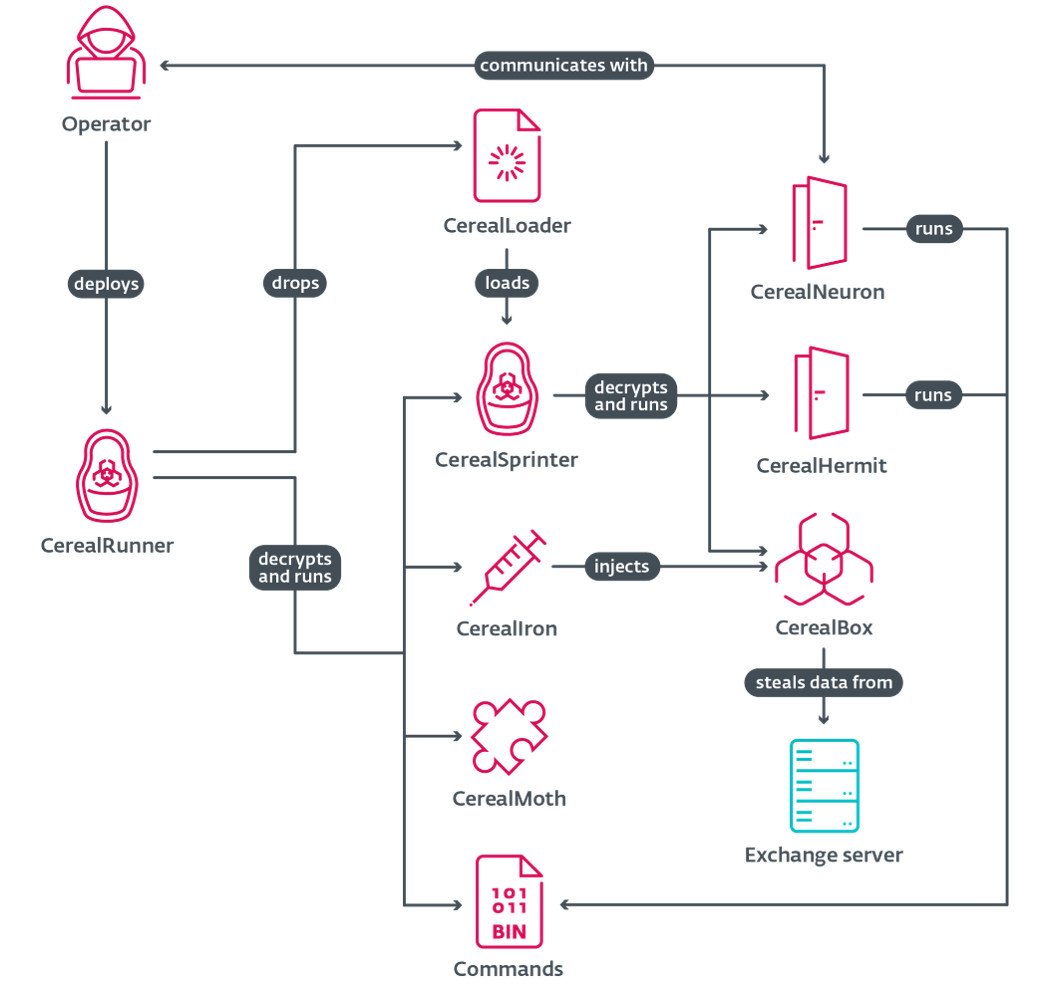
The Cereal toolset is designed to take commands, execute them in memory, and map the compromised organization while gathering selected messages through a newly developed email collection module. ESET noted that the toolset keeps its payloads encrypted and receives commands as separate .NET assemblies, executing the email collection module within Exchange's own processes. This sophisticated method indicates a deep understanding of Exchange internals combined with unique .NET execution techniques.
Matias Porolli, an ESET researcher, emphasized that the most significant activities on a compromised Exchange server often extend beyond the messages that arrive in a user's inbox. While ESET's research does not detail how the servers were initially compromised, it does provide indicators of compromise in its white paper and GitHub repository.
Targeting NATO and EU Communications
The Cereal toolset was specifically set to target NATO and EU emails at the Romanian victim, which was identified a month after ESET first detected the toolset in Kazakhstan on November 28, 2025. This targeting aligns with longstanding Russian intelligence priorities and may also be influenced by regional tensions, such as the reported crashes of Russian drones near Romania since early 2025. In Kazakhstan, the toolset's deployment may relate to the reported deportations of some Russian exiles since January 2026, suggesting that the operators are seeking insights into Russian dissidents.
Approximately 70% of the countries targeted by Turla since 2022 have been former Soviet republics or European nations that were once closely aligned with the Soviet Union, according to ESET telemetry. The research concludes that Cereal is designed for long-term, stealthy cyber espionage, with the victims' Exchange servers serving as collection points, internal execution hubs, and cover for Turla's .NET tradecraft, leaving minimal traces on disk.
Final Assessment
The implications of Turla's operations extend beyond mere data collection. The group's activities highlight the ongoing cyber threats faced by NATO and EU member states, particularly in the context of geopolitical tensions. As cyber espionage becomes increasingly sophisticated, the need for robust cybersecurity measures is paramount. Organizations must remain vigilant against such threats, ensuring that their systems are fortified against potential breaches.
In conclusion, the deployment of the Cereal toolset by Turla underscores the evolving landscape of cyber espionage. With a focus on high-value targets such as NATO and EU communications, the group exemplifies the persistent threats posed by state-sponsored actors in the digital realm. As nations grapple with these challenges, the importance of international cooperation and information sharing in cybersecurity cannot be overstated.