Bitter Hackers Unveil PapRAT Backdoor in Cyberespionage Campaign
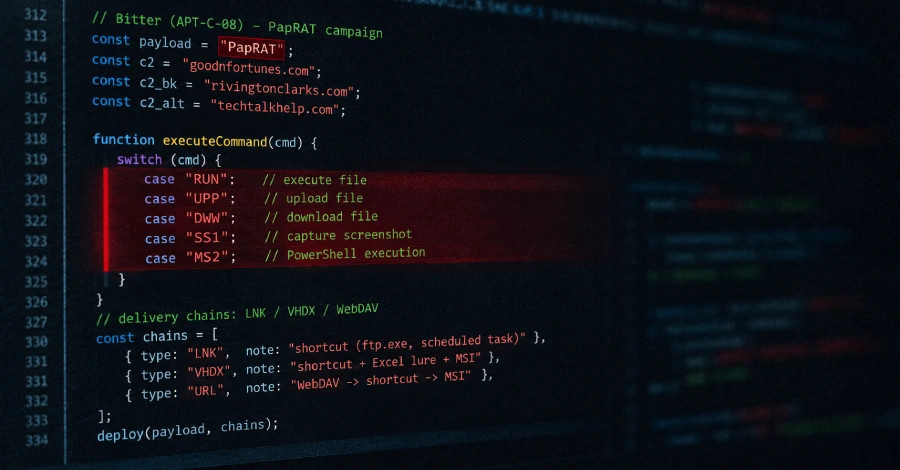
The South Asian cyber espionage group known as Bitter, also referred to as APT-C-08, has been observed deploying a new remote access trojan called PapRAT against organizations in South Asia. This malware has both C++ and Rust versions, enabling a range of capabilities such as command execution, file uploads and downloads, file deletion, and even screenshot capture. The Rust variant further enhances its functionality by allowing PowerShell execution among other commands.
The campaign is particularly notable for its use of three distinct infection chains. The first employs a living-off-the-land (LotL) technique, executing commands from a remote server identified as "goodnfortunes[.]com." This method enables the collection of various reconnaissance data, including directory and task lists, information from user folders, and details about installed antivirus products. The gathered data is then saved as "abc.pdf" and exfiltrated to the command and control (C2) server using a curl command, after which the original file is deleted from the host.
In a second variant of the attack, a script retrieves a file named "talk.log" from "techtalkhelp[.]com." This payload contains a Base64-encoded script that fetches additional instructions from the same server, executing them as PowerShell commands. This staging model provides attackers with operational flexibility, allowing them to update commands server-side without needing to deploy a new binary, which could be more easily detected by security systems.
Delivery Mechanism of PapRAT Malware
The PapRAT malware is delivered through an MSI installer in this second attack chain, designed for remote control and supporting eight commands. A Rust version of the malware includes three additional commands, enhancing its capabilities further.
Cleared for Release
The third attack chain combines elements from the first two, utilizing a script to download an MSI installer via curl. This installer acts as a conduit for PapRAT, which subsequently drops WmRAT, another malware previously associated with the Bitter group. These developments indicate that the threat actor is continuously refining its tools to maintain access to targeted systems.
Experts emphasize the need for organizations to monitor malicious behaviors across scripting tools, scheduled tasks, and installer activities, in addition to detecting known malware signatures. They advise caution regarding unexpected LNK files, URL shortcuts, disk images, and MSI packages, especially when received through unsolicited communications.