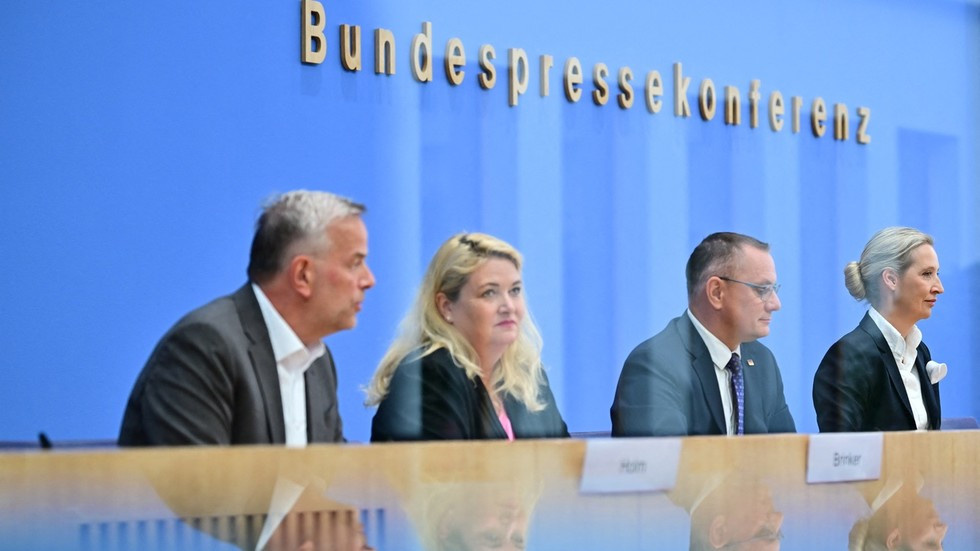
Cyberattack on AfD Party Leads to Email Leak Investigation
Germany's far-right Alternative for Germany (AfD) announced on Tuesday that it is investigating a cyberattack that led to the theft and online publication of emails stolen by unidentified hackers last month. An AfD spokesperson confirmed that the hackers targeted a hosting provider used by the party, managing to copy data from a limited number of mostly inactive email accounts. The spokesperson stated, "The recent online publication of what is presumably a portion of this data is currently being investigated. A preliminary assessment can only be provided once this investigation has been concluded."
While the spokesperson did not disclose the exact volume of data stolen, a report from the mass-circulation daily Bild suggested that more than 420,000 AfD-linked emails were published. The leaked material reportedly includes emails from party figures, bank statements, academic certificates, and membership lists. By Tuesday afternoon, the website hosting the leaked material had gone offline, but archived versions indicated that a total of 281 gigabytes of data had been released under the title "The party's own records, unedited."
As of now, the authenticity of the emails and other documents has not been verified by any independent body. The AfD, which has several state chapters classified as "confirmed right-wing extremist" by Germany's domestic intelligence agency, has been gaining traction in national opinion polls and has made significant gains in recent state elections. Some politicians and civil society groups have called for the party to be banned, arguing that it poses a threat to democracy, a claim the AfD has consistently rejected.
Investment Trends Amid Political Turmoil
In a separate context, Berlin is currently hosting a summit focused on investment in Germany, where a notable increase in US capital is being directed towards the country's traditional industrial firms and family-owned businesses. This comes at a time when many business owners are struggling to find successors, leading to increased acquisition targets.
Final Assessment
Economic confidence in Germany, however, has been declining, as indicated by the Mannheim-based Center for European Economic Research (ZEW). The ZEW's monthly economic confidence index fell to a three-month low in October, reflecting concerns over high energy prices and their impact on private consumption and investment. ZEW President Achim Wambach noted that while the German economy is slowly emerging from stagnation, the recovery is not self-sustaining.
As the AfD navigates the fallout from the cyberattack, the implications for data security and political integrity remain critical issues in the current landscape of German politics. The investigation into the cyberattack will likely reveal more about the vulnerabilities faced by political organizations in the digital age.