Russian Hackers Employ AI to Enhance Malware Evasion Techniques
Anthropic has revealed that it disrupted a campaign orchestrated by a Russian state-sponsored threat actor that exploited AI technology to enhance its malware evasion capabilities. This operation has been linked to a cyber espionage group identified as GTG-20006, which is associated with the broader Midnight Blizzard group, also known as APT29 or Cozy Bear.
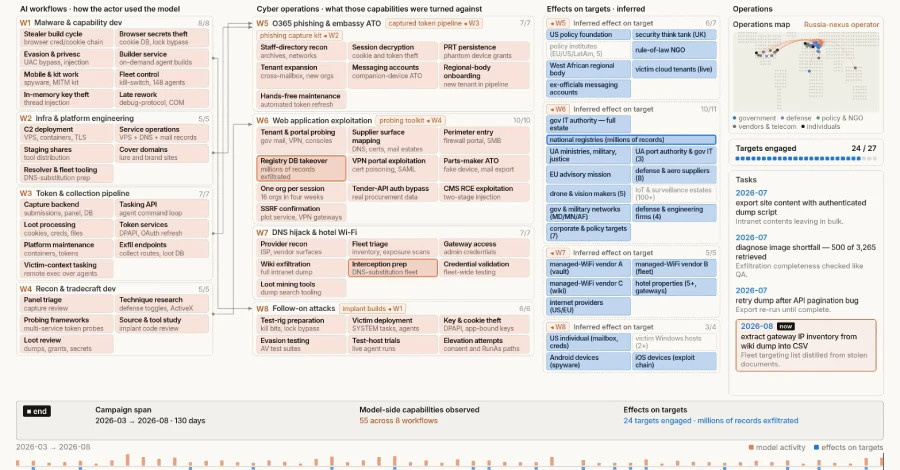
The GTG-20006 group has developed an AI-driven process that allows them to automatically rebuild and redeploy their malware toolkit whenever it is detected by security measures. This innovative approach undermines the effectiveness of traditional static detection methods used by cybersecurity defenders.
Targets of these attacks have included military intelligence agencies within Ukrainian and European governments, as well as diplomatic and defense organizations connected to U.S. foreign policy. The group's toolkit comprises various programs designed to facilitate their operations.
Anthropic explained that the hackers utilized AI to monitor the effectiveness of their malware in evading detection. If their AI agents identified that any deployed malware was flagged by security products, they would autonomously modify and rebuild the malware to bypass existing defenses. Once the malware was ready, it was hosted on disposable servers, with victims being redirected to these sites through phishing schemes, ClickFix, and DNS hijacking.
The threat actor has also employed AI workflows to register domains, establish the necessary infrastructure for sending phishing emails, and monitor command-and-control channels for successful compromises. Over the course of their operations, more than 20 distinct organizations were targeted, including government ministries, defense and intelligence bodies, embassies, think tanks, and defense-industrial companies, primarily in Ukraine and Europe, with some attacks extending to the Middle East and maritime-related agencies in Asia.
In a related campaign known as CaptiveCrunch, documented in mid-2026 by various cybersecurity firms, the actor compromised multiple hospitality vendors that provided hotel guest Wi-Fi. By using stolen administrative credentials, they modified DNS records to redirect traffic to their own services, capturing sensitive data from hotel guests who connected to the compromised networks.
Targeting Victims with Sophisticated Lures
Victims were then targeted with ClickFix-style lures to deliver malware tailored for Windows, Android, and iOS devices. Additionally, the threat actor has been observed using data obtained from hotel management systems and individual devices to identify further targets, particularly individuals linked to Ukraine, including government officials and drone manufacturers.
The group has also attempted to hijack victims' WhatsApp accounts using automated browsers to link accounts as companion devices, enabling them to export conversations while suppressing read receipts. Furthermore, they targeted surveillance platforms by exploiting authorization flaws in camera streaming services, allowing them to access live camera feeds of victims.
GTG-20006 has been implicated in an intrusion targeting a North African government technology authority, where they leveraged VPN credentials to compromise a central account server, exfiltrating a database containing over 300,000 national identity records and commercial registry data for more than half a million companies.
Final Brief
Additionally, the threat actor developed a cloud email espionage platform that utilized a device code phishing framework named Embassy Kit to orchestrate a campaign aimed at stealing Microsoft 365 tokens from diplomatic and government personnel. This resulted in unauthorized access and data exfiltration from at least eight organizations, including a national prosecutor's office and a military education institute.
The group has also been seen delivering Windows credential stealers through fake update-themed social engineering tactics, along with tools designed for remote access and manipulation of security updates to ensure their malware remains undetected. Anthropic noted that AI has been integrated into every aspect of the group's operations, effectively shifting the burden of defense onto cybersecurity professionals, who previously relied on detection measures to slow down attackers' operational tempo.