New Study Challenges Traditional 'Lizard Brain' Theory of Human Intelligence
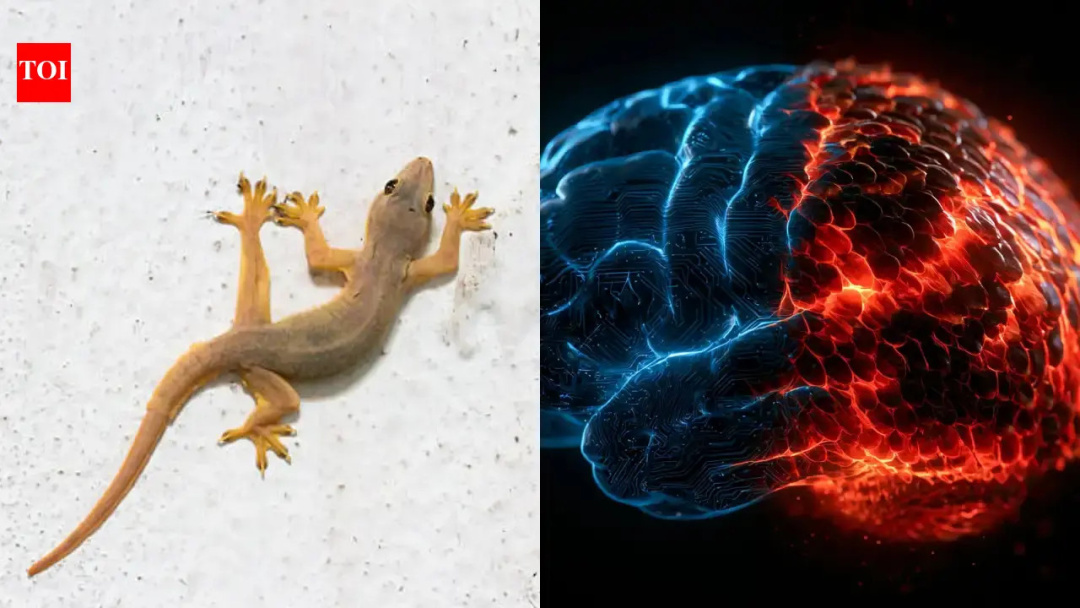
A recent study from Georgia Tech has brought into question the traditional 'lizard brain' theory, which has dominated discussions about human intelligence for decades. This theory, which dates back to the 1950s, posits that the human brain is structured in evolutionary layers, with basic instincts at the base, followed by an emotional 'reptilian brain,' and culminating in the advanced reasoning capabilities of the neocortex. However, the new research suggests that this view is overly simplistic and does not accurately reflect the complexities of brain evolution.
Published in the journal Science Advances, the study draws on comparisons between biological brains and experiments with artificial neural networks. The researchers argue that rather than a straightforward hierarchy, the evolution of the brain may have involved a competition between different wiring strategies for neural circuits. This competition was likely influenced by the limited space available in the brain, leading to a more intricate evolutionary process.
The study highlights that the neocortex, which is associated with higher functions such as vision and reasoning, occupies less space when certain parts of the limbic system are larger. This interconnectedness suggests that these brain regions do not function in isolation but rather as part of a complex system that evolves together across species.
To further investigate these ideas, the researchers utilized artificial neural networks to model how different wiring strategies compete for neural resources. They found that networks with localized connections excelled in tasks related to vision and sound, while those with distributed connections performed better in smell recognition and memory tasks. This modeling reflects the evolutionary trade-offs seen in various animal species, where the size and function of brain regions adapt based on environmental demands.
The implications of this research extend beyond understanding human evolution. It may also inform the development of artificial intelligence systems. Unlike contemporary AI, which often relies on vast amounts of training data, biological brains are prewired with certain structures that can be combined with experiential learning. By mimicking this architecture in AI, researchers hope to create systems that require less data and energy to learn effectively.
In conclusion, the study presents a paradigm shift in how we understand intelligence, moving away from the simplistic 'lizard brain' metaphor towards a more nuanced view of brain evolution as a balancing act between different neural processing strategies. This research not only challenges established theories but also opens new avenues for both biological and artificial intelligence research.