Aptos Price Outlook: Can APT Compete with Solana and Sui?
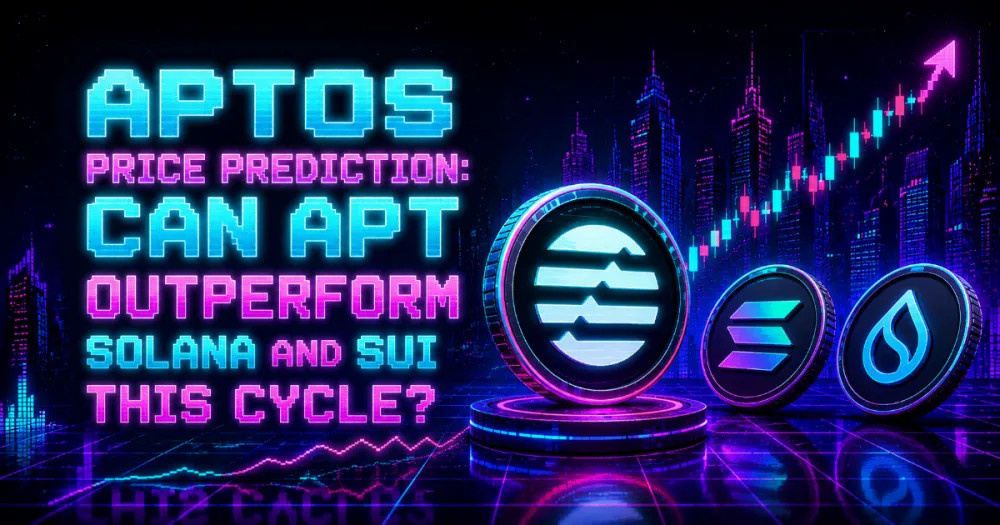
Aptos is a Layer 1 blockchain designed for fast transactions and secure smart contracts, developed by Aptos Labs, which includes former engineers from Meta's Diem project. The native token, APT, serves multiple purposes, including transaction fees, staking, and governance, with a focus on decentralized finance (DeFi) and institutional applications.
The blockchain employs a proof-of-stake mechanism and utilizes a unique transaction processing system called Block-STM, which allows for parallel execution of transactions, enhancing efficiency under load. Aptos smart contracts are written in Move, a programming language designed to minimize vulnerabilities.
Since its launch in 2022, Aptos has been compared to Solana, often referred to as the "Solana killer" due to its promise of high throughput and low fees. However, while Aptos's ecosystem is growing, Solana maintains a more substantial developer community and liquidity, making direct comparisons complex. Aptos, Solana, and Sui all aim for high throughput but differ in their core objectives: Solana focuses on ecosystem size, Aptos on enterprise infrastructure, and Sui on consumer applications.
Transaction costs on all three platforms remain low, with Solana typically charging less than a cent per transaction. Aptos and Sui also offer competitive pricing, making them suitable for high-frequency applications. Despite this, the average transaction confirmation time is sub-second across all three networks, with Aptos achieving rapid finality through its consensus architecture.
In terms of developer activity, Solana boasts one of the largest ecosystems in crypto, while Sui has more developers than Aptos but still trails Solana. The long-term price prediction for APT will likely hinge on developer growth and the overall health of its ecosystem.
Solana's DeFi landscape is robust, with numerous decentralized exchanges and lending protocols, while Aptos is developing its own ecosystem with protocols like Aries Markets and PancakeSwap. However, as of October 2023, Solana leads in total value locked (TVL) with over $5 billion compared to Aptos's $109 million.
Aptos has formed partnerships with major institutions, including Google Cloud and Microsoft, which could bolster its infrastructure and tokenization efforts. The blockchain is also exploring applications in AI and tokenized real-world assets. Despite these advantages, Aptos has not yet matched Solana's adoption levels.
Sui, another competitor, has gained traction with its object-oriented architecture, appealing to game developers and consumer applications. Both Aptos and Sui are vying for developer interest, but Solana's established network effects present a significant hurdle for Aptos.
The future of Aptos may depend on its ability to convert technological strengths into user adoption and liquidity growth. Analysts suggest that while Aptos has potential, it must overcome substantial gaps in adoption compared to Solana and Sui. The ongoing development of its DeFi ecosystem and institutional partnerships will be critical for its long-term success.
In summary, Aptos faces a challenging landscape as it competes with Solana and Sui. While its technology is promising, the blockchain must enhance its adoption metrics to become a leading player in the Layer 1 space. The outlook for APT remains uncertain, with predictions varying widely based on market conditions and ecosystem growth.