Hubble Telescope Captures Stunning Image of Ancient Star Cluster
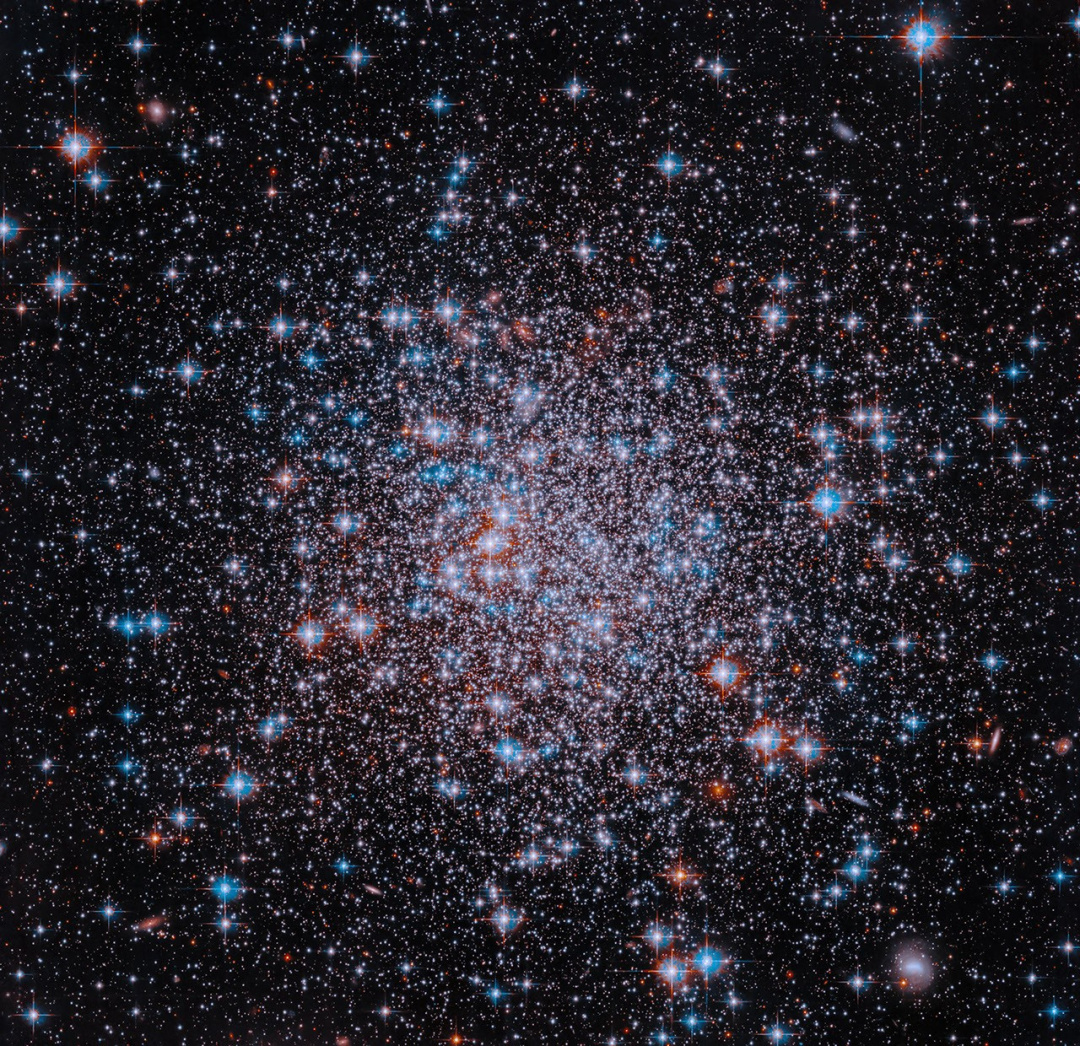
NASA's Hubble Space Telescope has released a captivating image of the globular cluster NGC 6426, coinciding with the United States' 250th anniversary. This cluster, situated in the outer halo of the Milky Way galaxy, consists of stars bound by gravity and is one of 150 known globular clusters in our galaxy. NGC 6426 is approximately 13 billion years old, nearly as old as the universe itself, which is estimated to be 13.7 billion years old.
In the image, blue hues represent shorter wavelengths of visible light, while red indicates longer wavelengths and some near-infrared light. The color variations in Hubble's images are based on standard processing techniques that accurately reflect the light wavelengths captured during observations. The blue stars are hotter, while the red stars are cooler, showcasing the temperature differences among the stars.
The stars in NGC 6426 exhibit low metallicity, meaning they contain fewer elements heavier than hydrogen and helium. This characteristic mirrors the conditions of the early universe, where matter was predominantly composed of helium and hydrogen, with heavier elements forming through nuclear fusion in massive stars.
Research indicates that NGC 6426 contains two distinct populations of stars, with the younger, more metallic stars enriched by materials from the explosive deaths of earlier stars in the cluster. Supernovae from massive stars distribute heavier elements into the universe, contributing to the formation of new stars and planets.
Hubble's imaging of NGC 6426 is part of a broader study of globular clusters in the Milky Way's halo, aimed at determining their ages and enhancing our understanding of the galaxy's formation and evolution. Over its three decades in orbit, Hubble has significantly advanced our knowledge of the universe, with its findings complemented by observations from other NASA missions, including the James Webb Space Telescope and the upcoming Nancy Grace Roman Space Telescope, set to launch in late summer.