Brazilian Police Raid Clandestine Workshop Producing 3D-Printed Firearms
On June 26, 2026, the Civil Police of Rio de Janeiro raided a clandestine workshop in Rio das Pedras, where a group was reportedly using a 3D printer to manufacture firearm components. Investigators found that the group produced pistol frames and structural parts for rifles using polymer, later completing them with metal components. While initial reports suggested the metal parts were imported, police were still investigating their origin. The operation targeted an international arms trafficker supplying criminal organizations.
Recent Brazilian cases indicate a trend where the final assembly of firearms is occurring closer to end users, with documented workshops relying on external suppliers for ammunition and functional metal parts. Following the U.S. designation of the Primeiro Comando da Capital and the Comando Vermelho as terrorist organizations, these supply relationships have become critical for investigative leads.
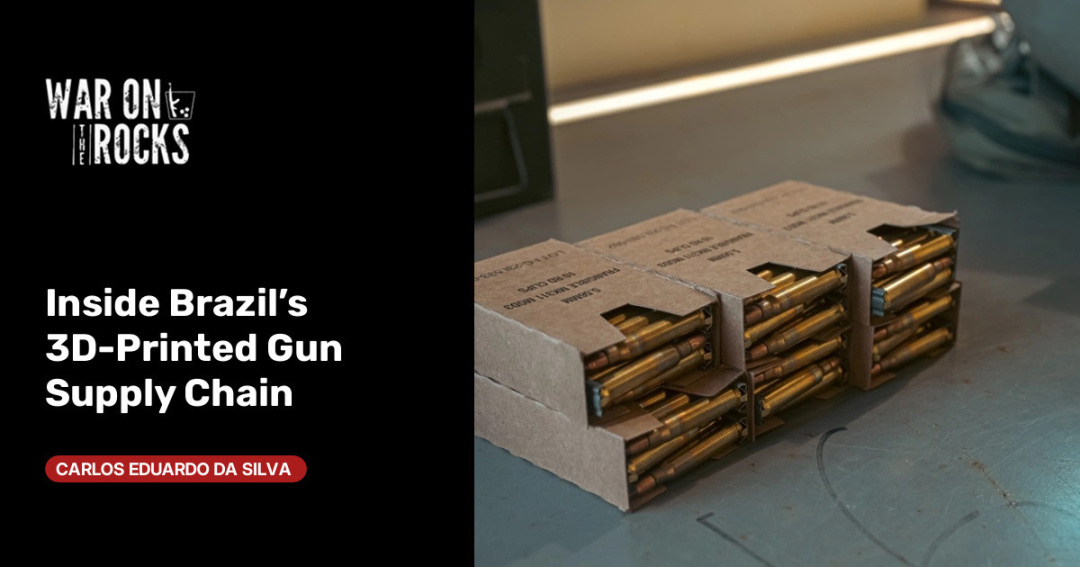
Brazilian media framed the raid as part of a broader narrative about criminals manufacturing their own firearms. However, significant investigative leads stem from the supply chain, particularly concerning ammunition acquisition. Investigators revealed that the group used falsified credentials to purchase over 10,000 rounds of ammunition from a specialized dealer and a manufacturer within a few months. Notably, none of this supply crossed international borders, and the 3D printer could not replace the essential inputs required for the weapons to function.
Having spent 23 years with the São Paulo Civil Police, I can attest that seizures like these are first viewed as logistical challenges before being seen as technological issues. The driving question in such investigations is who supplied what. In 2026, this question gained new legal significance. Following the recent designations, knowingly providing weapons or components to either organization can lead to federal criminal liability under U.S. law.
Brazil has seen an increase in documented cases involving 3D-printed firearms. On March 12, 2026, a coordinated operation led by the Civil Police of Rio de Janeiro dismantled a structured network involved in the development and sale of 3D-printed firearms and accessories. Code-named Shadowgun, this operation executed multiple search and arrest warrants targeting suspects across several states, aided by Brazil’s intelligence agency.
Other cases illustrate the infiltration of 3D printing technology into clandestine workshops. Authorities have dismantled networks that printed weapon components and stored finished barrels. Analysts describe Latin American firearms markets as hybrid systems where legal, diverted, and improvised weapons coexist, noting a growing presence of 3D-printed firearms. The barriers to entry appear to be diminishing as technical knowledge spreads through encrypted platforms and online repositories.
Empirical studies primarily associate 3D-printed firearms with criminal activity, lone actors, and small workshops, while sustained organizational supply chains remain rare. A dataset documenting incidents from 2013 through July 2024 linked many of these incidents to criminal activity and terrorism, with most involving individuals acting independently.
In Brazil, direct evidence linking 3D-printed firearms to the Primeiro Comando da Capital or the Comando Vermelho is still scarce. Open-source reports have connected some online images to the Primeiro Comando da Capital, but these instances appear to be isolated experiments rather than established supply channels. A previous case in São Gonçalo involved a printed weapon seized from an individual associated with the Comando Vermelho, but a single seizure does not confirm that 3D printing serves as a regular supply channel for these factions.
Brazil’s largest criminal networks continue to rely on the diversion and trafficking of conventional firearms. Seizure data indicate that Brazil, the United States, Germany, and Belgium are leading manufacturers of military-style firearms. Criminal groups utilize these firearms to control territories and confront law enforcement. Printed and hybrid firearms constitute a small segment of this market, but their significance lies in what they reveal about the adaptation of established supply chains.
Durable 3D-printed firearms are categorized as hybrid weapons. Leading designs combine a printed polymer body with metal pressure-bearing components. Consumer-grade plastic cannot substitute for these parts, as weapons printed entirely from polymer are less reliable. A weapon intended for repeated use requires metal, particularly in the chamber area where firing pressure is highest.
These metal components do not necessarily have to originate as regulated firearm parts. Developers have created designs that require no commercially produced firearm components. In a country with a robust steel industry, these materials do not need to cross borders.
Operation Shadowgun revealed the design and distribution aspects of this market. Prosecutors charged an engineer with developing a polymer carbine released through online repositories. The design spread beyond Brazil, with police in New Zealand seizing one in 2025. Builders can fabricate the weapon almost entirely from polymer using domestic printers, although it still requires functional parts and accessories.
The Brazilian cases discussed involve two types of inputs, each leaving a distinct investigative trail. When a finished barrel or bolt reaches a workshop through a commercial channel, the transaction reveals more about the buyer’s intent than the purchase of general-purpose tools. Seizures cannot directly explain why documented workshops obtained functional parts separately when local fabrication was feasible. They demonstrate the outcome rather than the rationale.
Ammunition remains a dependency that documented workshops have not replaced. None of the cases examined involved the production of functional cartridges. Brazil possesses domestic manufacturers and a vast licensed retail network, which the credential fraud in Rio das Pedras exploited. In these cases, 3D printing alters weapon assembly but does not replace the ammunition supply.
Roberto Uchôa’s analysis of Rio de Janeiro’s rifle economy traces this trajectory. He argues that the emergence of ghost guns and 3D-printed receivers reflects an increasing domestic production capacity within Rio’s criminal ecosystem. Groups assemble and partially manufacture weapons closer to the point of use, rather than receiving complete imported rifles.
Neither Uchôa’s analysis nor the open sources reviewed for this article document workshops producing pressure-bearing components from commercial stock. An early indication of that shift would be forensic evidence in a Brazilian case of a barrel rifled from commercial tubing. If such recoveries became a pattern, the investigative window would be closing.
Operation Florida Heat serves as the clearest documented example of cross-border component sourcing. In 2022, this operation dismantled a network that procured firearm components in the United States and assembled the weapons in Brazil. This case illustrates one model of the arms trade, not a universal pattern, and incorporates U.S.-linked individuals into the supply chain.
On May 28, 2026, the United States designated the Primeiro Comando da Capital and the Comando Vermelho as Specially Designated Global Terrorists. Under U.S. law, anyone who knowingly provides material support to a designated organization may face criminal liability. The Supreme Court has determined that the statute requires knowledge of the group’s designation, not a specific intent to further that activity.
If a supplier knowingly provides a rifle to a designated organization, the same legal issues arise whether the supplier diverted the rifle or assembled it from trafficked parts. Printing adds an additional stage to a supply chain that the statute can reach. Potentially exposed actors extend beyond traffickers moving complete firearms across borders. They may include intermediaries importing components or workshop operators finishing firearms for factional buyers.
Digital design files present a separate legal question. The Supreme Court has ruled that independent advocacy falls outside the statute, while coordinated activity with a designated organization does not. The critical factors are what the supplier knew and who received the support.
The Rio das Pedras workshop exemplifies how the arms trade is adapting through local assembly, while also revealing the limitations of that change. Investigators noted that the group printed the polymer frame on-site, but the components necessary for the weapon's functionality were sourced externally. The supply side offers investigators more actionable leads than the printer does, as the ammunition transactions passed through licensed sellers with existing records.