Foreign Agricultural Land Holdings Near U.S. Military Sites Raise Concerns
Foreign holdings of agricultural land in the United States have garnered heightened regulatory and public scrutiny, particularly regarding national security risks associated with acquisitions linked to adversarial nations near military installations. A recent study investigates the spatial distribution of these foreign land transactions, particularly those connected to the People's Republic of China (PRC). The research indicates a notable increase in public discussion about foreign agricultural land ownership since 2020, which aligns with a wave of state-level legislation introduced to limit foreign acquisitions, especially from adversaries like the PRC.
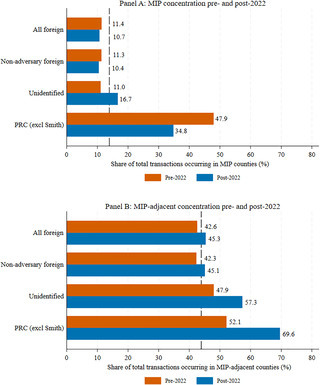
The study utilizes transaction-level data from the Agricultural Foreign Investment Disclosure Act (AFIDA) covering the years 1996 to 2024 to assess the relationship between foreign land transactions and U.S. Military Interest Points (MIPs). The analysis reveals that approximately 43.7% of PRC-linked transactions occur in counties with MIPs, compared to about 11% for transactions from non-adversarial foreign entities. The presence of MIPs is associated with a higher probability of transactions being linked to the PRC, while no such association is found for non-adversarial transactions.
Additionally, the research notes a shift in PRC-linked transactions from MIP counties to adjacent counties following the legislative changes in 2022. This shift, along with an increase in transactions reported under unidentified-origin codes, raises questions about the transparency of foreign land ownership and the potential risks it poses to national security. The findings underscore the need for ongoing policy discussions regarding foreign agricultural land ownership, particularly in relation to military infrastructure.
The study also employs social media listening techniques to gauge public interest in foreign land ownership by adversarial nations. This approach allows researchers to capture public discourse over time, providing insights into how legislative actions reflect voter concerns about national security. The analysis reveals that while the volume of foreign land ownership is relatively small, the strategic implications of land proximity to military sites warrant further investigation.
Overall, this research contributes to the understanding of foreign agricultural land holdings in the U.S. and their implications for national security, highlighting the importance of spatial analysis in assessing the risks associated with foreign investments in agricultural land.