ESET Uncovers Turla APT's Cereal Toolset Targeting Exchange Servers
ESET Research has detailed a new toolset known as Cereal, which has been found operating on Microsoft Exchange servers. This toolset was first identified on November 28, 2025, at a government agency in Kazakhstan, and subsequently at a Romanian government body on December 23. In Romania, the tool was configured to monitor emails related to NATO and the European Union, indicating a targeted approach by the Turla APT group, which has been active since at least 2004.
The U.S. Cybersecurity and Infrastructure Security Agency (CISA) has assessed that this group is affiliated with Center 16 of Russia’s Federal Security Service (FSB). The name Cereal derives from the serialization process used in programming to package data and code for transfer. The toolset primarily consists of modular .NET code that is encrypted, unpacks itself in memory, and leaves minimal traces on disk, with only the initial loader saved as a standard .NET file.
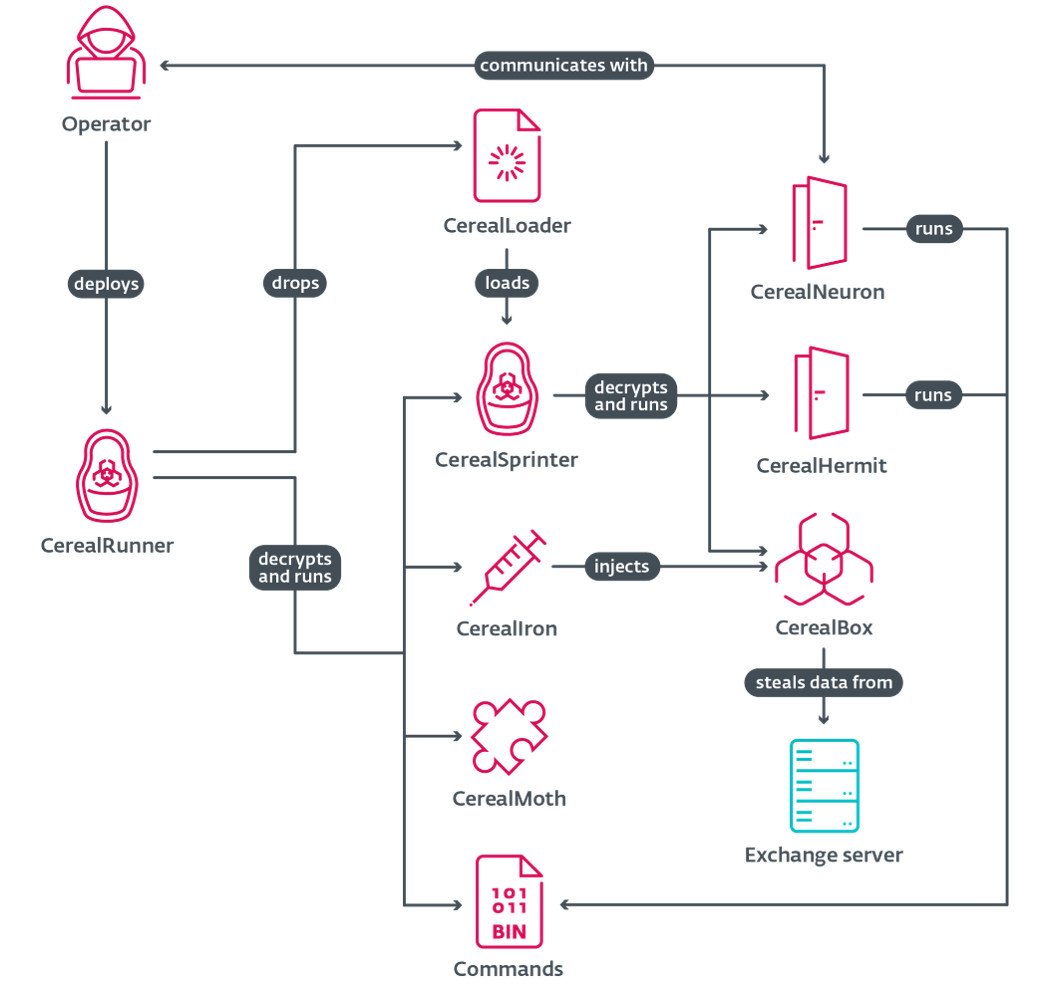
One notable aspect of Cereal is the absence of an attacker-controlled server. The main backdoor, referred to as CerealNeuron, operates directly on the victim's Exchange server, waiting for commands through web paths that mimic normal Outlook Web Access, Autodiscover, and ActiveSync traffic. This design complicates detection efforts, as any anomalous requests that fail security checks simply return a standard Exchange error page.
According to ESET's analysis, CerealNeuron is a passive backdoor that lacks built-in commands but can execute assemblies received through network requests. This method poses significant challenges for defenders, as there is no external server to target for disruption. ESET was unable to trace the attackers' IP addresses, further complicating the response to these threats.
A second variant, named CerealHermit, operates without network functions and retrieves encrypted command files directly from disk, providing attackers with multiple avenues for access. The commands executed by this toolset are designed as disposable programs, allowing operators to send tasks as small compiled .NET programs via a component called CerealRunner. These tasks include accessing mailboxes, querying Active Directory, and extracting Windows credentials.
Cereal's Stealthy Email Injection Tactics
The stealthy nature of Cereal is underscored by its ability to inject itself into the EdgeTransport.exe process, which manages email flow within Exchange. This injection method allows CerealBox, a module of the toolset, to operate without registering itself, making it difficult to detect within Exchange’s configuration. The module targets messages containing specific file types and sender/recipient combinations, compressing and encrypting selected emails for later retrieval by the attackers.
The targets of these attacks align with Turla's historical focus, as approximately 70% of the countries targeted since 2022 have been former Soviet republics or European nations with ties to Russia. The emphasis on Romanian NATO and EU email systems reflects Russia's ongoing intelligence objectives. Additionally, the attacks in Kazakhstan are linked to the country's deportation of Russian exiles, with increased activity noted following significant political events.
Approved for Dissemination
Organizations utilizing Exchange servers are advised to monitor for suspicious activities that may not be evident in standard configurations. This includes checking for unusual DLL files and unexpected requests to the web paths associated with the backdoor. A clean list of Exchange transport agents does not guarantee that the mail system is secure from compromise.
The Cereal toolset exemplifies a sophisticated approach to long-term cyber espionage, demonstrating that for the Turla group, Exchange servers serve not only as mail servers but also as critical points for data collection and execution of commands.